
League of Legends Rank Distribution 2026 and Account Value
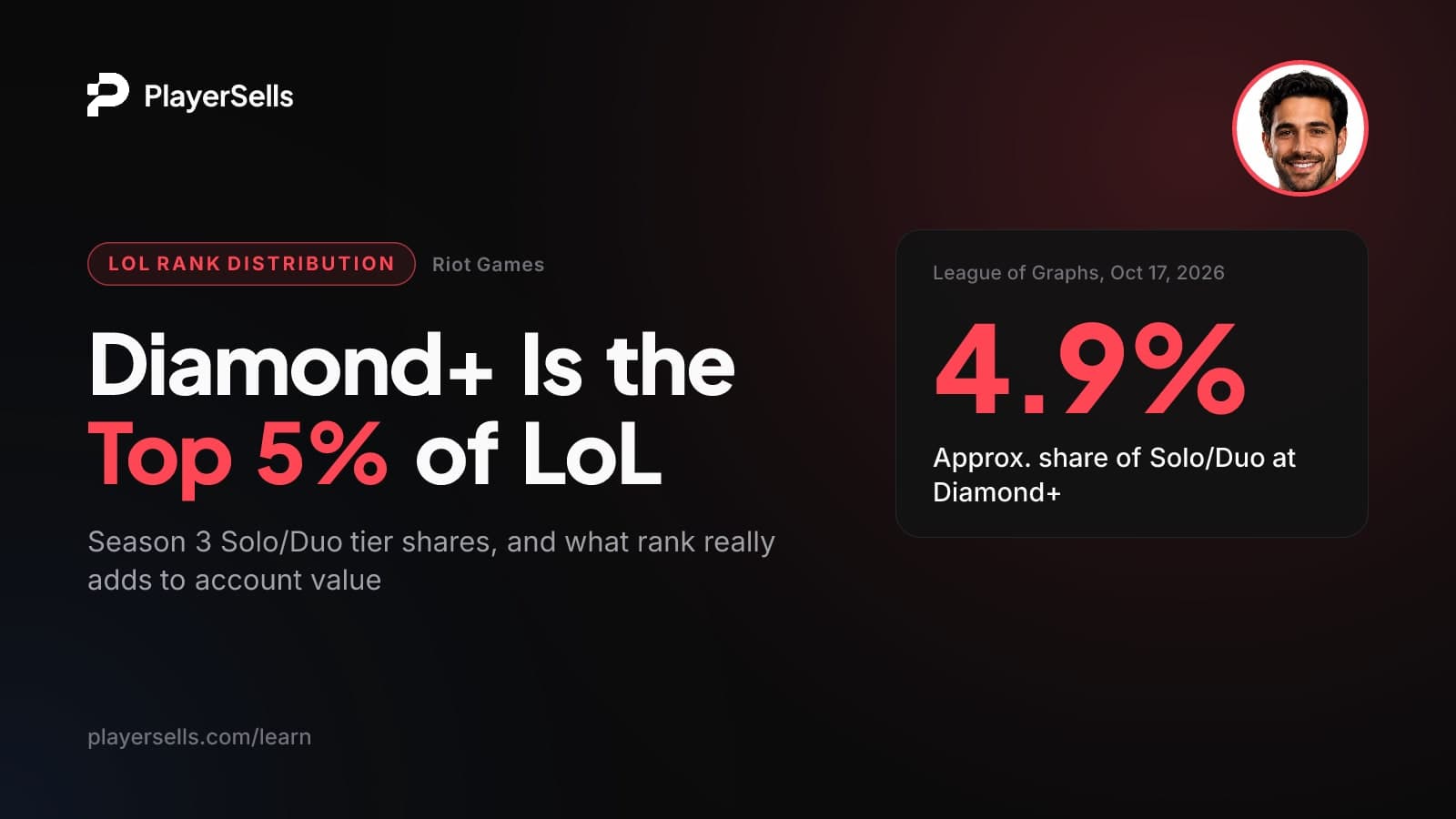
Gold is the most common LoL rank at 23% and Diamond+ is about the top 5%. See every tier's share this season and what really drives LoL account value.
According to League of Graphs' tracked Solo/Duo data as of October 17, 2026 (Season 3, Patch 26.20), Gold is the most common League of Legends tier at 23%, followed by Silver at 21% and Platinum at 18%. Diamond and above is roughly the top 5% of players. Master, Grandmaster and Challenger together make up less than 1%. These are tracker figures, not official Riot numbers. On account value, Riot's Terms of Service forbid selling or transferring accounts and say virtual content has no monetary value, so any price comes from a gray market where buyer and seller can both lose the account.
Below you'll find the full tier table, cumulative "top X%" figures, why players pile up at division IV, how 2026's three-season structure shapes the numbers, how far to trust trackers, and what Riot's rules mean for account value.
Key takeaways
- As of October 17, 2026, League of Graphs' global Solo/Duo data puts Gold as the largest League of Legends tier at 23%, ahead of Silver at 21% and Platinum at 18%.
- Diamond and above is approximately the top 4.9% of tracked Solo/Duo players. Emerald and above is approximately the top 17.9%, and Master and above is approximately the top 0.87%.
- The most common single division is Gold IV at 8.3% of tracked Solo/Duo players, because players who promote into a new tier land at division IV and many stay there.
- In 2026, rank carries over between Season 1, Season 2 and Season 3, and the main ladder reset happens in January. The exception was April's hard reset of Master, Grandmaster and Challenger players to Master 0 LP in NA, EUW, EUNE, BR, LAN and TR.
- Riot's Terms of Service forbid selling, transferring or sharing a League account and state that virtual content has no monetary value. Any resale price exists only in a gray market where both buyer and seller can lose the account.
- Rank is the least durable part of an account's perceived value, because January resets, apex resets and decay erode it, while limited items like Victorious skins stay with the account for as long as Riot does not terminate it.
What is the League of Legends rank distribution right now?
Gold is the biggest tier, and the ladder is shaped like a hill that peaks in Gold and thins out sharply above Emerald. The table below uses League of Graphs' global rank distribution for Solo/Duo, checked on October 17, 2026. The right-hand column is our own running total of the site's rounded figures, counted from the top down.
| Tier | Share of tracked players | This tier or higher (approx.) |
|---|---|---|
| Challenger | 0.021% | 0.021% |
| Grandmaster | 0.05% | 0.07% |
| Master | 0.8% | 0.87% |
| Diamond | 4% | 4.9% |
| Emerald | 13% | 17.9% |
| Platinum | 18% | 35.9% |
| Gold | 23% | 58.9% |
| Silver | 21% | 79.9% |
| Bronze | 16% | 95.9% |
| Iron | 3.6% | All tracked players |
Two notes on reading it. First, the site rounds each tier, so the shares don't add up to exactly 100%. Treat every cumulative figure as approximate. Second, League of Graphs labels the current patch "16.20," while Riot now numbers patches by year as "26.20." Both labels refer to the same patch.
These are not official numbers. Riot does not publish rank percentages, so every rank distribution you see online comes from a third-party tracker like this one.
What does your rank mean as a "top X%" figure?
Read the right-hand column as your percentile. If you are in a given tier, you are roughly in the top share shown for that tier. Here is how the main milestones look on this snapshot:
- Gold is roughly the top 59%. About 41% of tracked players sit in a lower tier, so Gold is the middle of the ladder, not the bottom.
- Platinum is roughly the top 36%.
- Emerald is roughly the top 18%. On these numbers, an Emerald player is in a higher tier than about four in five tracked players.
- Diamond is roughly the top 5%. This is the point where the ladder gets thin.
- Master and above is under 1%. Challenger alone is about 0.02%.
Percentiles inside a tier are not even, and that matters more than most people expect. Someone in Gold IV and someone in Gold I share a tier, but far more players sit at the bottom division than the top, as the next section shows.
Why do so many players sit in division IV?
Each tier's bottom division is the most crowded, because promoting into a new tier drops you at division IV. Many players then stall there before climbing further. On League of Graphs' global Solo/Duo ladder, Gold IV is the most common division at 8.3%, followed by Platinum IV at 7.4%, Silver IV at 6% and Emerald IV at 5.3%.
The pattern breaks at the edges. Iron IV holds just 0.43% of tracked players, since it is the floor of the ladder and nobody promotes into it. Diamond IV is only 1.5%, because few players reach Diamond at all. So the division IV bulge is mostly a mid-ladder effect, where the most players are trying to cross each tier wall.
Why are the apex tiers so small?
Grandmaster and Challenger are capped, not just hard to reach. According to LoLTheory's rank guide, major servers such as EUW, NA and KR cap Grandmaster at 700 seats and Challenger at 300. Grandmaster also needs 200+ LP and Challenger needs 500+ LP. Caps vary by server, which is one reason apex percentages differ between regions.
How does ranked work in 2026?
2026 has three ranked seasons, but rank only fully resets once, in January. Switching seasons mid-year does not wipe your rank. That is why the distribution in October looks like a ladder that has been climbing since January, not a fresh start.
| Season | Dates | Patches | What happened to rank |
|---|---|---|---|
| Season 1 | January 8 to April 28, 2026 | 26.01 to 26.08 | Started after the January reset |
| Season 2 | From April 29, 2026 | 26.09 | Rank carried over. Master+ hard reset in six regions |
| Season 3 | From July 29, 2026 | 26.15 | Rank carried over. Victorious win count restarted |
| Season 3 end | Not announced | Last scheduled 2026 patch: 26.24 (December 9) | January reset expected, date unconfirmed |
The season dates and the December 9 patch come from the Nerfplz ranked season tracker, a fan site that cites Riot's patch notes. The same tracker, citing Riot Support, says players usually start a new year about one full tier below their final rank. It adds that nobody can start higher than Emerald I. Check Riot Support for the current wording before relying on it.
The Master+ hard reset
On April 21, 2026, Riot announced a hard reset for apex players in NA, EUW, EUNE, BR, LAN and TR. Every Master, Grandmaster and Challenger player in those regions went back to Master 0 LP, both visible rank and MMR, when Patch 26.9 launched Season 2. Riot made the change after months of apex volatility, including patches that swung between +10/-30 LP and plus or minus 20 LP. It was regional, not global.
Other 2026 changes that shape the ladder
In its Ranked 2026 dev post (December 2025), Riot said it was recalibrating lower tiers to better match actual skill and was explicitly "not inflating ranks." It also brought Flex ranks closer to Solo/Duo, though Flex never pulls Solo up. Duo queue came back at all ranks in most regions. Patch 26.15 then tightened apex duo again, according to secondary coverage from esports.gg:
- Master players under 200 LP can duo with Diamond I.
- Master players within 400 LP of each other can duo.
- Grandmaster and Challenger players, or players with MMR at those ranks, can't duo.
How reliable are rank distribution trackers?
Trackers are useful for the shape of the ladder, but they are not a census. League of Graphs only counts the players it indexes. It reports percentages, not totals, and its numbers shift daily and are rounded. Any site that turns these percentages into exact player counts is guessing, so we don't.
This also explains why guides disagree. Some older pages still show Silver and Gold at 25% each, or Master above 1%. Those are stale snapshots from different points in a season. A rank distribution is only meaningful with a date, a source and a patch attached, which is why this page names all three.
Does rank distribution change by region?
Yes, a little. On LAN, League of Graphs shows Solo/Duo Emerald at 14%, Platinum at 19%, Diamond at 4.1%, Master at 0.9% and Challenger at 0.026%. That is slightly top-heavier than the global figures of 13%, 18%, 4%, 0.8% and 0.021%. Server size, seat caps and regional events like the April apex reset all move these numbers.
Flex is a separate ladder with its own distribution. Riot has pulled Flex ranks closer to Solo/Duo in 2026, but Solo/Duo remains the figure most players and trackers mean by "rank."
How much is a League account worth?
Officially, nothing. Riot's Terms of Service say players have no ownership or property interest in the virtual content they unlock. They also say that content "has no monetary value," cannot be redeemed for real money, and that the license ends immediately if Riot terminates the account. Any price an account fetches comes from a gray market that operates against those terms.
We don't publish dollar figures for League accounts. There is no neutral price source. Most "how much is my account worth" pages are written by sellers with a stake in the answer. What we can describe is what the gray market looks at, and how long each factor holds up.
| Factor | Why buyers look at it | How durable it is |
|---|---|---|
| Rank rarity | Diamond+ is about 4.9% of tracked players and Master+ about 0.87%, so high ranks look scarce | Temporary. January resets, regional apex resets and decay all erode it |
| Account level | Signals playtime and history | Stays with the account while the license lasts |
| Champion pool | More owned champions means less grinding for the next user | Stays with the account while the license lasts |
| Skins, especially limited ones | Victorious skins need 15 ranked wins (Solo/Duo, Flex or both) plus Honor level 3 or higher at season end, according to the Nerfplz tracker citing Riot Support | Stays with the account. Limited rewards can't be earned again later |
Why rank is temporary value
A Diamond rank in October is not a Diamond rank in February. The January reset typically drops players about a tier, and in 2026 apex players in six regions were sent back to Master 0 LP mid-year. Rank also depends on whoever plays the account next. A buyer who can't hold the rank will drop back down, so the rank itself is the weakest part of any valuation.
Limited cosmetics are what make an account rare in a lasting way. The Victorious win count restarted at the Season 3 launch on July 29, according to the Nerfplz tracker. Each season's reward is tied to that season. The same logic, comparing list price with what an account actually resells for, applies to other game accounts. Our guide on Steam account list vs resale value walks through that gap.
Can you get banned for buying or selling a LoL account?
Yes. Section 1.5 of Riot's Terms of Service is titled "Can I share or sell my account or login credentials? (No.)" It says you can't share an account, can't sell or transfer it, and can't let anyone else access it or offer to do so.
Riot's rules prohibit buying, selling, transferring and sharing League accounts, and sharing an account can lead to a permanent ban. Any account sale carries that risk for both the buyer and the seller.
Riot's Community Pact adds two points that marketplace guides tend to skip. Boosting, queue boosting and smurfing count as rank manipulation and are penalized when detected. And if Riot detects someone using an alternate account while another of their accounts is restricted, the penalty may apply to the alt as well. Continued bad behavior can stack penalties across accounts, including the main.
The recovery scam
Riot Support's shared accounts article calls accounts personal, non-transferable and free, and says buying and selling them is strictly prohibited. It describes a common scam: the seller takes the money, then recovers the account through Riot. The original owner usually holds the recovery details, so a buyer who pays directly has little recourse.
On legality: selling a League account violates Riot's Terms of Service, which is a contract matter. It is not automatically a crime, and the legal picture varies by country. The practical consequence most people face is a ban, not a court case.
Buying or selling a League account on PlayerSells
If you go ahead despite Riot's terms, the risk you can reduce is the one between buyer and seller. Escrow protects the payment until the buyer confirms delivery. It does not change Riot's rules, cannot stop Riot from acting on an account, and cannot stop a former owner from trying to recover the account through Riot after the deal completes.
On PlayerSells, the buyer pays PlayerSells and the money is held. The seller is paid only after the buyer confirms the account was delivered as described. Every deal follows the same sequence: offer sent, accepted, payment pending, paid, delivered, buyer confirmed, completed. Either side can open a dispute before completion. A human moderator reviews it, and the money stays held while the dispute is open. The how it works page covers each step.
Every listing in the League of Legends category is reviewed by a person before it goes live. Before you confirm delivery, check the rank, level, champion count and any skins listed on the account against the description. Make sure you control the login and recovery details. Our safety guide lists what to check, and fees are on the pricing page.
Frequently asked questions
What percent of players are Gold in League of Legends?
About 23% of tracked Solo/Duo players are Gold, according to League of Graphs on October 17, 2026. That makes Gold the largest tier. Gold IV alone holds 8.3% of tracked players, more than any other single division.
Is Emerald a good rank in LoL?
Yes, Emerald is an above-average rank. Emerald and above is roughly the top 17.9% of tracked Solo/Duo players on League of Graphs' October 2026 snapshot. Emerald IV is the most crowded Emerald division at 5.3% of all tracked players, about two in five Emerald players, so the top of the tier is rarer than the bottom.
How many players are in Challenger?
About 0.021% of tracked Solo/Duo players globally, according to League of Graphs on October 17, 2026. Trackers report percentages, not player counts. According to LoLTheory, Challenger is capped at 300 players on major servers such as EUW, NA and KR, with 500+ LP required. Caps vary by server.
When does LoL ranked Season 3 2026 end?
Riot has not announced an end date as of October 17, 2026. The last patch on the 2026 schedule is 26.24 on December 9, according to a fan tracker. Past years suggest the January reset lands in early January 2027, but that is only an estimate.
Does rank reset every season in League of Legends?
No, not in 2026. Rank carried over when Season 2 and Season 3 started, and the main reset happens in January. The exception was the April 2026 hard reset that sent Master, Grandmaster and Challenger players in NA, EUW, EUNE, BR, LAN and TR back to Master 0 LP.
Is it illegal to sell a League of Legends account?
Not automatically. Selling an account violates Riot's Terms of Service, which is a contract issue, and can lead to permanent bans. Whether it has any further legal consequences depends on where you live.
Bottom line
If you only wanted to know where you stand: Gold is the middle of the ladder, Emerald is roughly the top 18% and Diamond is roughly the top 5%. Read any tracker figure as a dated, approximate snapshot, not an official count.
If you are weighing what your account is worth, value the parts that last, like limited skins and champion pool, over a rank that resets in January. Accept that Riot's terms make any sale a ban risk for both sides. If you still decide to trade, use escrow, verify everything before confirming, and browse reviewed League of Legends listings rather than paying a stranger directly.

Published by the PlayerSells editorial team. Data comes from PlayerSells marketplace records and our own crawlers. About PlayerSells · Editorial policy
Related Articles
Continue learning with these related guides.

Do Streamers Keep Simulcasting? 10,328 Tracked for 4 Weeks
Week to week, 42.3% of Kick and Twitch simulcasters stop. Of 10,328 streamers tracked for four weeks, 49.3% did it in one week, 15.4% in all four.

YouTube Automation and Inauthentic Content: Buyer Risks
Is YouTube automation legit? Yes, but YouTube won't monetize mass-produced content. See the inauthentic content rule and how to vet a channel before buying.

Did YouTube's New View Count Inflate Views? 3,565 Channels
After YouTube began counting views from the first frame on Aug 24, 2026, the median large channel gained public views 12.5% faster. 3,565 channels measured.